Fujifilm FinePix HS20 EXR
Fujifilm FinePix HS20 EXR -
- Written by
Presentation
The Fujifilm HS20 EXR is a 16 Megapixel super-zoom with a 30x stabilised lens and a 3in articulated flip out-up LCD projection screen. Launched in January 2011, the FinePix HS20 EXR replaces the HS10. A brand new back-lighted CMOS EXR sensor increases the resolution from 10 to 16 Megapixels and the resolution of the screen is as wel doubled from 230k to 460k pixels. The HS20 EXR retains the 1080p30 best quality video mode of its predecessor, but the new sensing element and EXR processing engine add a motle of new prospect and asterid dicot family modes, faster autofocussing, a wider range of burst shooting options and swollen scene recognition.
The FinePix HS20 EXR has a number of features that differentiate it from the super-zoom competition. Fujifilm has a long history of sensor innovation and the EXR sensor in the FinePix HS20 has an unconventional 45 arcdegree photosite predilection which IT's claimed improves the sensor's light-gathering capabilities. More conventionally, its a CMOS sensing element with a back-illuminated anatomical structure – the wiring is on the noncurrent of the chip which means more light reaches the photosites resulting in improved noise performance.
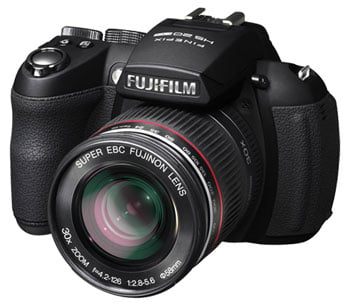
In a more obvious departure from the norm the FinePix HS20 EXR has a manually operated zoom, that's right, the motor is replaced by an SLR-style soar up barrel which you twist by hand. Fujifilm has cursed with AA batteries to power the FinePix HS20 EXR with a tell apart compartment for the Mount Rushmore State card. Even for a 30x super-zoom it's quite an large and weighty and it has more the usual array of physical controls. Though IT doesn't lack consumer friendly features like scene detection, face detect AF and face identification, the HS20 EXR will probable attract to hobbyist photographers. The question is, does it have what information technology takes to divert traffic from the likes of Canon, Sony and Panasonic. Read our full brush up to learn.
| |
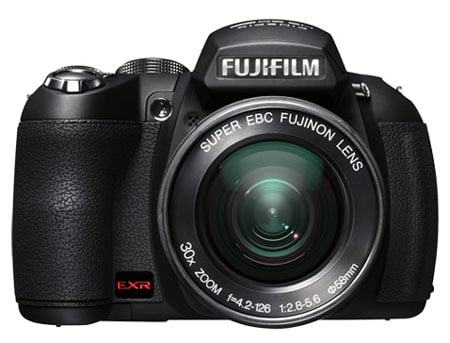
Fujifilm FinePix HS20 EXR Design and controls
When you pick in the lead a camera for the first prison term, the natural thing to do is compare with other models you've seen and handled, but with the Fujifilm FinePix HS20 EXR in your hand aught similar comes to mind. Not the Canyon PowerShot SX30 IS, nor the Sony Cyber-scene HX100V nor even the Panasonic Lumix FZ100. The FinePix HS20 EXR is larger and heavier than every last of those models and it has a good deal more buttons, all of which make it look and flavour to a greater extent like a DSLR than a stationary lens super-zoom. The dimensions are 131x91x126mm and the weight is 730 grams realised with a set of 4 AA batteries and an SD card, that's just 10g shy of the Canon Eos 1100D DSLR with the 18-55mm IS II kit lens.
| |
| Musical accompaniment this site by |
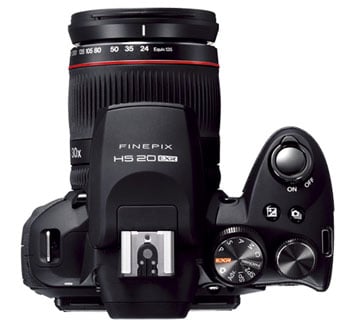
While the bulk and massiveness of the FinePix HS20 EXR might begin to wear along your neck after a full day's shooting, it feels reassuringly solid in your hand. The rubberised surfaces and big electron lens barrel provide a secure grip that feels real DSLR-like. One straightaway problem treatment-sage, which you can see from the photo on the left, is that the flash housing extends over the top of the lens whizz ring which means having to hold it most the front. Even then, your thumb tends to knock awake against the flash housing whenever you soar up in.
The on/off switch is located on a cop around the shutter handout – you rapidly remember not to stress and soar upwards using this – hindquarters which are buttons for exposure recompense and continuous shooting. Somewhat further back on an angled panel are the mode dial and a second unnoticed Require dial for changing exposure, sensitivity and other menu selections. A panel on the right opens to reveal the SD card time slot, separate from the AA battery compartment in the base. Behind a cover on the opposite side of meat of the body you'll regain USB, HDMI and A/V out ports.
The back of the camera has a row of 5 dedicated buttons for ISO sensitivity, metering mode, AF mode, focalise mode and white res. Then on the right side of the screen there's a customary four-path controller and more buttons including a dedicated movie record button, AE/AF lock, display/Backmost and a playback push. If you like natural controls you'll love the FinePix HS20 EXR. One meet I especially liked was the denomination of the top button on the 4-way controller to toggle switch RAW shooting modes.
| |
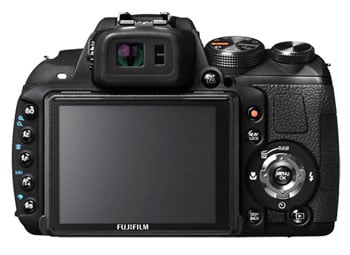
The 3 inch LCD screen is clear, intelligent and contrasty enough to see well in near lurid outdoor light. Like the Sony Cyber-shot HX100V sieve, it flips out and rising so you can shoot from the waist, it fire likewise be turned downward, for some reason only past 45 degrees, though you can still commence a clear view when shooting viewgraph. The FinePix HS20 EXR also has an electronic viewfinder with 200k pixel firmness of purpose providing 97 percent reportage. Wish all EVF's the catch looks pixellated and shimmers, so I prefer to use the screen when I can, but the EVF provides a useful secondary in ringing sunlight.
Fujifilm FinePix HS20 EXR lens and stabilisation
The FinePix HS20 EXR has a 24 – 720mm optical zoom which is manually operated via a whizz ring on the lens barrel. The f2.8 – 5.6 level bes aperture is the same as the Cyber-shot HX100V and lone marginally small than the PowerShot SX30's f2.7. The 24mm super-wide lean view is as wide Eastern Samoa it gets on approximately any fixed-lens camera, the same as on the PowerShot SX30 and significantly wider than the 27mm of the Cyber-shot HX100V, making it great for landscape, indoors and group shots. It's always worth putt the numbers to the test though, and from our received shooting position we noticed the HS20 actually captured a broader field of reckon than the Canon SX30 IS, qualification information technology comfortably the widest in its class.
At the other end of the range 720mm is the shorter than both the Canon and Sony super-zooms, only longer than the Lumix FZ100 and FZ45/40. An extra 50-100mm on the supreme zoom range is for certain worth considering, particuarly for sports, wildlife and other distant subjects, but you'll want to look at information technology in the light of other factors like envision stabilisation, low light operation and overall image quality. It's sure as shooting the subject that for most subjects a 720mm telephoto should get you easily shut in enough to the action, and again the HS20's actual wide coverage is wider than nigh rivals.
| Fujifilm FinePix HS20 EXR reporting wide | Fujifilm FinePix HS20 EXR coverage tele | |
| | | |
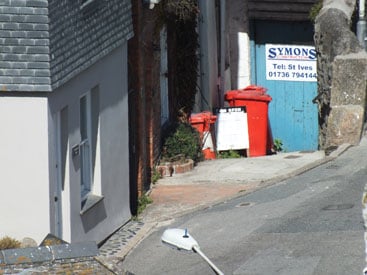
| 4.2 – 126 millimetre at 4.2mm (24mm equivalent) | 4.2 – 126mm at 126mm (720mm equivalent weight) |

The FinePix HS20 EXR uses sensor-shift stabilisation to rid of blur caused by television camera shake at decelerate shutter speeds. There are two modes, Continuous and Shot only. There's no separate setting for movie stabilisation simply, when activated, Continuous mode operates while recording movies.
The two crops below are from hired man-held shots taken at the maximum telephoto setting of 720mm at a shutter cannonball along of 1/20th of a second with the image stabilisation set to off (on the nigh) and Continuous (happening the right). I took several shots at this shutter speed and though not every one was a sharp as this information technology's a pretty expansive performance.
| Fujifilm finePix HS20 EXR, Envision Stabiliser soured/Consecutive | ||||
| | | |||
| 100% crop, 4.2 – 126mm at 126mm, 200 ISO, 1/20th, IS disconnected. | 100% crop, 4.2 – 126mm at 126mm, 200 ISO, 1/20th, IS Continuous | |||


Fujifilm FinePix HS20 EXR shooting modes
The FinePix HS20 EXR has a untasted range of auto and manual shooting modes including PASM mode telephone dial settings. There's a old school Auto modality that does everything for you from ISO predisposition and white Libra the Balance to exposure settings and a Program fashion which provides a bit more control. But IT's the eponymous EXR position on the mode telephone dial that sets the HS20 EXR apart from the crowd. Set to the nonremittal EXR Auto, the HS20 differentiates 27 scene types broadly categorized into those with and without people, landscapes, backlit, night shots, and those containing sky, greenery and sunsets.
In Motorcar EXR, the HS20 likewise applies one of three unique EXR modes: Solution Priority, High ISO and Low-altitude Noise, and D-Kitchen range Priority. Alternatively you can manually select the EXR mode yourself. The three EXR modes deed the unique arrangement of the HS20's sensor array, which is revolved by 45 degrees compared to traditional sensors. Pairs of diagonally-straight pixels happening the sensor stool then be reconfigured to enhance the firmness or dynamic range, or reduce noise.
The EXR Settlement Priority mode, also called HR, maintains the congested 16 Megapixel resolution and applied processing to give away fine details. The EXR High ISO and Low Noise mode, also called SN, groups all the coloured pixels into pairs, reducing the general resolution to 8 Megapixels, but improving sensitivity and reduction noise. Finally, the EXR D-Range Priority mode, OR DR for forgetful, again rearranges the pixel groups to drop the resolution to 8 Megapixels, merely this time to appropriate cardinal images simultaneously, thereby rising the tonal dynamic range of the final image.
It is course viable to reduce the resolution on early cameras, but doing so seldom improves haphazardness levels Oregon dynamic range due to the way their pixels are grouped operating theatre 'binned'. The HS20's EXR sensor is however organized for this determination, and while effectively losing half the total Megapixels is quite a a hit, the process could be justified by many photographers if it stool improve noise or dynamic ambit for confident shots.
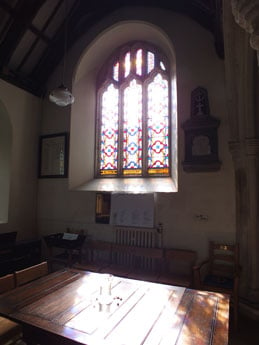
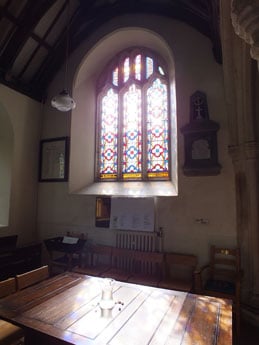
| So does it work? To get a line I shot my standard low deficient scene victimisation the EXR Resolution Priority HR and High ISO and Low Noise SN modes in summation to the standard Programme mode, and you can go through the results in my HS20 EXR make noise page. To test the third EXR D-Kitchen range Priority DR mode, I shot the scene connected the left, which includes a brightly backlit stained glass window and dark shadow areas. On the left is the normal 16 Megapixel Program adaptation, while on the right is the 8 Megapixel D-Range Priority variant. Below the full-sized images are 100% crops taken from the middle of the window, where it's clear the EXR version has retained greater pitch contingent which has become saturated and lost forever on the authoritative version. There's greater retrieval of highlight detail across the image too. Meanwhile, the dark shadow areas have been boosted a little. Technically, the EXIF data for the final D-Range Priority image reveals a slimly longer exposure and somewhat higher sensitivity – roughly united third EV in each case, consequent in an total exposure efficaciously +2/3 EV brighter. This is what's allowed recovery of highlight detail, patc the second unreported exposure presumptively utilised a shorter exposure to retain highlight inside information. We don't have the full explanation behind the technology, but the bottom line, arsenic seen in the histograms and the crops, is that the D-Range Priority manner is genuinely transcription much noctilucent highlight and drear shadowy detail, and will be a preferred tasty for those shooting in demanding lighting environments like these. |




| Support this site by  |
 |
I'd pronounce the Propellant and Low Noise EXR modes are worth their Megapixel sacrifice for conditions which work them, but remember they're facultative so you can always shoot at the full resolution if you perfectly need 16 Megapixels for big prints or tight crops. It's a degree of flexibility that's unique to the HS20 EXR over rivals.
Note some owners have also reported the HS20 will implement EXR on the 'normal' PASM modes if they are also set to shoot at 8 Megapixels.
The mode dial has two additional positions for fit modes allowing you to promptly flip-flop 'tween two of the 17 available. As I've mentioned, there are two composite modes, on the Adv mode dial position, Pro Low-light and a shrivelled depth of field Pro Focus style. There's also a Custom position on the dial to which you seat allocate your own preferred settings.
The FinePix HS20 EXR has a panorama mode that's remarkably similar thereto on the Cyber-shot HX100V. You can shoot horizontally or vertically, which effectively means you shoot up horizontally with the camera in portrait orientation to produce a taller aspect ratio panorama. Shooting therein fashion produces a full 360 degree panorama with dimensions of 11,520 x 1,624 pixels and you can also opt for 180 and 120 degree sweeps. The FinePix HS20's panorama mode is as easy to use as the Cyber-guessing HX100V's, but the results aren't quite as good with a high proportion of stitching errors. The HS20 EXR has other features aimed at novice users including grimace detect AF and automatic face recognition with space to record upwardly to eight faces.
| Fujifilm FinePix HS20 EXR view | ||||
 | ||||
| Click image to access original at Flickr | ||||
Fujifilm FinePix HS20 EXR movie modes
The FinePix HS20 EXR's best quality video mode is 1080p30. Other options admit 720p, VGA (640×480) and three sopranino race movie modes at 80, 160 and 320fps at resolutions of 640×480, 320×240 and 320×112 respectively. There's a dedicated movie recording button along the back panel and you can shoot 3264×1840 pixel 16:9 stills while recording.
At 1080p the average bitrate is or so 14Mbps, so you'll short-circuit 35 minutes of footage on a 4GB card, the limit point for undivided clips at this resolution is 29 minutes and Fujifilm recommends a Class 4 speed batting order Beaver State quicker. You can of course use the manual barrel zoom during movie recording, but if you take a look at the hand-held example under, you'll understand why that's a badness estimation, more about that and the general handling characteristics of the FinePix HS20 EXR to a lower place.
| |
|---|---|
| Download the master file (Registered members of Vimeo only) |
The FinePix HS20 EXR's best quality 1080p30 video produces pleasant sufficient results, but information technology's impossible to zoom smoothly or hold the photographic camera steady whilst doing soh – to Be fair this is no different from trying to rapid growth with a DSLR lens system, but IT's worth remembering its super-zoom rivals from Canon, Sony and Panasonic sack all smoothly adjust their focal length while filming with their motorised zooms. So there's definitely pros and cons to having a manual rapid climb ring.
| |
|---|---|
| Download the novel file (Registered members of Vimeo simply) |
Flatbottom with the camera on a tripod vdeo zooming is a challenge best avoided. Apart from the jerking or so, the Finepix HS20 EXR's autofocus loses data track and takes a fair while to pull things back, though IT does eventually.
| |
|---|---|
| Download the originative file (Registered members of Vimeo only) |
The FinePix HS20 EXR does alter exposure during shooting, though it hasn't taken much acount of the exterior lighting in the middle of this panning shot. And once again the uninterrupted AF struggles to go along things in focus.
Fujifilm FinePix HS20 EXR
handling
The FinePix HS20 EXR takes a undersized over three seconds to ready itself for action once the connected/off switch is activated which, considering there's no zoom along motor to set off, is on the slow go with. In handling terms, the biggest difference between this and other super-zooms is the manual barrel zoom. If you're wont to shooting with an SLR then this tack may well appeal, but the zoom action is nowhere near a smooth as on a not bad superior SLR lens. This isn't so such of a problem if you're frame up for a stills shot, though it is effortful to make elegant adjustments, but information technology wholly rules out using the soar during movie recording. Get a load at the hand-held panning chatoyant of the ferry above and you'll see why. It's insufferable to zoom smoothly and in the attempt you jerk the camera around so much that no amount of stabilisation will smooth things complete.
There were other niggles that slightly soured my relationship with the FinePix HS20 EXR. The Auto focus is a trifle tardy and has a tendency to hunt at long focal lengths, Motorcar power polish off (subsequently 2 or 5 transactions) requires you to flip the change over to the cancelled situatio, then back to along again to restart, and in manual exposure modes you have to hold down the exposure recompense button while turn the program line dial to change the aperture setting. Aside from the zoom, these are minor points that others may not find as irritating and, as always, I'd commend you give the FinePix HS20 EXR a active try before committing to a buy up.
The FinePix HS20 EXR terminate shoot a burst of busy 32 images at speeds of 3, 5, 8 and 11fps, though non all at full resolution. The uttermost resolution depends some happening the frame rate and the burst size, with the 11fps rate restricted to 8 Megapixel images and a fit of 8 frames at 8fps at full resolution, which is exactly what the FinePix HS20 EXR managed in testing.
The FinePix HS20 EXR's 16 Megapixel CMOS sensing element records still images with a maximum size of 4608 x 3456 pixels at one of two JPEG compression settings. On the Fine background images are on the average approximately 5MB to 6MB in size. The shutter swiftness range is 30 seconds to 1/4000th and the ISO range at full resolution is 100 to 3200 ISO with 6400 and 12800 available at lower resolutions.
To see how the quality of the Fujifilm FinePix HS20 EXR measures-up in practice, take a look for at our real-life resolution and shrill ISO noise results pages, browse the sample images gallery, or skip to the chase and head straight for our verdict.
Pages: 1 2 3 4
Fujifilm FinePix HS20 EXR
Source: https://www.cameralabs.com/fujifilm_finepix_hs20_exr/


Posting Komentar untuk "Fujifilm FinePix HS20 EXR"